
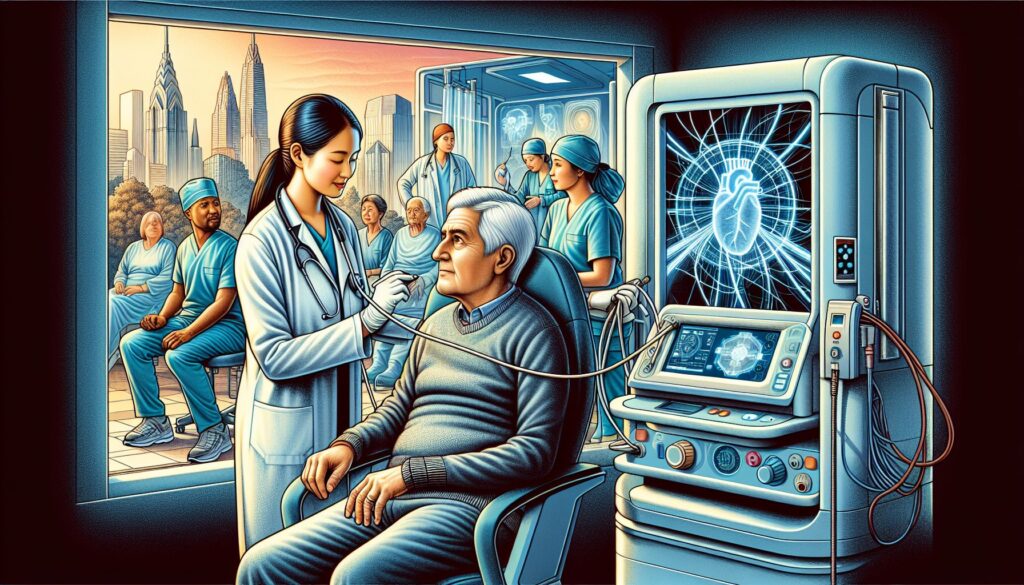
The landscape of healthcare has always been a buzzing hub of innovation, and recent advancements offer some of the most revolutionary changes yet seen. Every step forward holds potential to greatly improve patient outcomes, make care delivery more efficient, and to empower those who give and receive healthcare. Within this rich tapesty of modernization, a dossier of statistics reflects intensifying demand and rising possibilities: globally, the healthcare market was valued at about $8.45 trillion in 2018 and is expected to reach $11.9 trillion by 2022, signifying strong growth driven significantly by technological innovation.
The Frontiers Being Redefined: How Innovation is Shaping Healthier Futures
Innovations in healthcare encompass a broad spectrum of developments, including robotic surgery, wearable devices, gene editing, and telemedicine. Imagine surgeons, equipped with robotic arms, conducting intricate surgeries beyond the limitations of human dexterity; patients tracking their own health with devices boasting an array of sensors; DNA being edited to eliminate genetic disorders; and physicians providing care across vast distances via virtual means.
What drives this epic saga of healthcare change? Primarily, the search for enhanced efficacy and efficiency, the rising costs that necessitate optimized delivery, and not to forget, increasing expectations of informed patients. The rapid pace of technological achievements serves as the very lifeblood of this evolution.
Bridging Distances with Telemedicine
Remote care, telemedicine by its formal moniker, stands out as a gleaming beacon of progress, catalyzed into near-ubiquity by thees pandemic when traditional in-person consultations became impracticable, if not altogether hazardous. Encompassing services like virtual appointments, remote patient monitoring and mobile health applications, this arm of healthcare innovation isn’t just for times of global health crises. It’s solidifying its place as a mainstay service, addressing lack of access in rural locales, ensuring consistent touchpoints for chronic illness, and mitigating the exposure of immunocompromised individuals.
Data-Driven, Personalized Healthcare
Underpinning much of today’s innovations is big data—massive influxes of information processed with algorithms that border on the arcane. Big data has launched us into the age of personalized medicine, hailed as the pinnacle of patient-centered care. No more broad-spectrum approaches; healthcare can now home in on individual’s unique physiology, lifestyle, and environment.
The Infinity of Genomics
Diving beneath that is genomics, and its clinical counterpart, pharmacogenomics—the art and science of understanding how a person’s genetic makeup influences their response to drugs. The ultimate game-changer here is malicious-cell assassin, CRISPR technology, that can snip away genetic errors with precision we could only dream of before. This suggests a nigh future where debilitating diseases like cystic fibrosis and sickle cell anemia could be consigned to bleak memories of the health horrors from whence we’ve emerged.
Cybernetic Surgeons–Just Science Fiction?
Take a stroll down the corridors where the future of surgery is currently being brainstormed, and rub shoulders with ‘da Vinci’, not the maestro from the annals of Renaissance but the state-of-the-art robotic surgical system. Emanating the aura of sci-fi tropes made reality, robotic systems enhance a surgeon’s skillset, bringing 3D visualization and mechanics that transcend the wobbles and jerks of mere mortal stead. Yet, this is no automated takeover—humans remain ever in command, upscaling their expertise not replaced by mechanical know-how.
Tackling Loftier Mountaintops: Innovations in Patient Engagement and Prognostics
Now shift gaze to blossom another paradigm shift—patient engagement platforms aplenty are transforming passive recipients into assertive agents of their own health odysseys. Apps, patient portals, and gamified experiences impart the power of knowledge and encourage adherence to therapeutic regimens. Knowledge is promptly, soundly being placed squarely into the palms of the ones who stand to benefit the most from it.
Lets Talk Prognostics
When reflection swings towards anticipating or diagnosing health concerns before they burgeon into crises, artificial intelligence (AI) takes the podium. AI, with its maze of neural networks and endless dataset ingestions, formulates diagnostic prognostics leaping strides beyond mere human faculties. Algorithms that pick up patterns in image-based diagnoses translate into better—even prescient—care, giving professionals rearview mirrors that can glimpse future deteriorations.
The Calculus of Utilizing Machine Learning
Machine learning—a close cousin of AI—inspects and decrypts nuggets of insights from titanic health records, guiding health interventions. By weighting each parameter with mathematical earnestness, it calculates preemptive recommendations that astound medication adherence professionals and preventative strategists alike. It contours new maps for ventures into otherwise nondiscript health data.
The Cost vs. Quality Debacle
Few can tread the fabled lands of healthcare without colliding with the twin pillars of reality—cost and quality. Highfalutin notions find solid deployment when they bear the promise of reduced healthcare-related expenditures while thrusting quality skywards. Through minimally invasive procedures and efficient, timely care delivery, innovations carve swathes through running and capital expenses, giving economists and financial stewards much to ponder.
Medical service progression stands at the cusp of reflecting higher survival rates, shortened recovery periods, and widespread access—but never isolated from watching the dutiful guardians of the bottom line.
Swipe, Tap and Mobile-Integrate Your Wellness
Please don’t undervalue those powerful little conveniences in pockets worldwide—smartphones. Anchored cuttingly on the wave of mobile integrations, personalized health is steadily sitting comfy in many a person’s daily routine. Launch widgets that ledger step counts, inquire surreptitiously into cardiac rhythms, and observe fluctuations in blood glucose level—all intertwined in the tapestry of an ordinary day.
Equity and Access: Ensuring Not Just Innovations, But Fair Applications
Now to draw the curtain, not fully, less afore celebratory cannonades of applause, heed one talk of equity. Paced collectively with impressive impetus, this area begs acquiescence and approachment to even inner mount solitudes and continuous strides to prevent merely opulent pedestals from basking in the glow of privileged therapeutic triumphs.
All in quick-hand, society must prepare, for the age dawning is one of marvels undreamt till our forecome edges upon transformative footholds near unfathomed. Mobilize entire bulwarks of ingenuity, collective will, and unyielding benevolence to wrap warmth-R&D around solution spoutings, thus permitting poised breakthrough parades to foster packed worlds suffusive with fevered delight in progression’s ripened revelation.
A Path Luminous with Promises Ever Bright
In your imaginings perambulate about a not-so-distant morrow with revolutionized medical wards—flash musings wherein lab-grown organs partition long, languid transplant lists, AI-powered vocal assistants serve information sound as ancient scholars, and care penetrates even the loftiest nooks of topographic and socio-economic clusters.
You journey amid embarks to visionary terrain, foregrounding regal possibilities flurrying to substantial sunrise when discussions orbit healthcare’s emerging evolvable avatar—vestments indeed aglow with brisk enlightenment and plucky daring,