
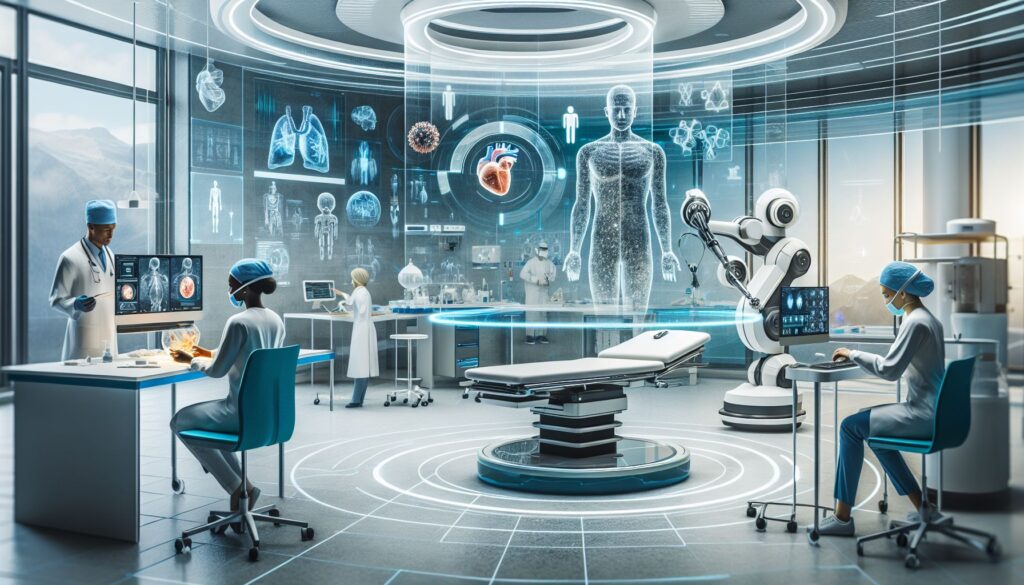
Welcome to the threshold of a new era in medicine, where technological marvels unlock groundbreaking advancements, leading to invaluable benefits in patient care and healthcare management.
The Dawn of a New Healthcare Era
The global healthcare landscape is undergoing a monumental shift, propelled by exponential advancements in technology and the imaginative minds behind inventive solutions. Historically, healthcare has always been at the forefront of embracing innovations aimed at improving patient outcomes and streamlining processes. In recent times, the intersections of medicine, technology, and innovative people have woven an intricate fabric that enhances every aspect of healthcare delivery. The numbers narrate this stirring transformation, with the digital health market projected to exceed a staggering $500 billion by 2025, reflecting leaps in tech adoption by healthcare providers worldwide.
Breakthroughs Bridging Gaps in Patient Care
The Telemedicine Expansion
With the ever-increasing demand for comprehensive and convenient healthcare, telemedicine innovations stand at the forefront of expanding access. Telemedicine allows medical professionals to diagnose, treat, and manage patients remotely, bringing board-certified expertise directly to homes or remote areas. What was once a niche service for rural areas has evolved into a healthcare staple thanks to virtual consultations, mobile health monitoring applications, and AI-driven diagnostic tools, demonstrating exceptional growth rates exceeding 15% per year.
AI and Machine Learning: Diagnosing Diseases with Unprecedented Precision
Artificial Intelligence (AI) coupled with machine learning algorithms represent profound shifts in disease diagnostics. AI’s capacity to analyze large datasets has improved diagnostic accuracy even in complex cases like radiology and pathology. Advanced software can now discern intricate patterns in imaging scans with superhuman precision, pinpointing anomalies that the keenest human eyes might miss. The integration of AI in diagnostic processes doesn’t just cut down on time; it also enhances early disease detection, critical for improving patient prognosis.
The Advent of Personalized Medicine
Tailored treatments and custom prophylactic strategies are fast becoming a stark reality thanks to personalized medicine. Techniques like gene editing with CRISPR, pharmacogenomics, and precision oncology are enabling health practitioners to devise patient-centric strategies. Personalized medicine acknowledges the subtle genetic variances between individuals, revamping the “one-size-fits-all” approach that previously typified medicative prescriptions and healthcare responses.
Harnessing Big Data for Proactive Healthcare Decisions
Data is undoubtedly the spine of modern healthcare progress. Big Data analytics empowers healthcare systems to predict outbreaks, cure diseases, lower costs, and improve the quality of life. Through the scrutiny of health records, search engine queries, and wearable device data, healthcare providers can forecast epidemics, direct resource allocation, and develop preventative measures. Predictive analytics, drawn from Big Data, has shown efficacy not only in outbreak management but in personal healthcare decisions, promoting a shift towards preventative care – a paradigm forecasted to reduce chronic disease prevalence by 57% by 2050.
Wearable Technology: Vital Monitoring Outside Hospital Walls
The proliferation of wearable technology signifies a potent shift towards empowered patient self-management. Wearables facilitate continuous monitoring without hospital admission. Tools like smartwatches that can measure ECGs and smart shoes embedded with pressure sensors are reshaping patient montoring, enabling subtle health shifts detection before acute episodes.
Robotic Surgery & Rehabilitation: Precision Beyond Human Capabilities
Robotic technologies are transforming surgery, with robotic arms offering superior precision and smaller incisions leading to reduced recovery times. With haptic feedback and AI, surgeons master intricate procedures remotely or enhance their abilities within the operating room. Robotic rehabilitation aids, propelled by advanced mechanics and AI, assist in the recovery of stroke and spinal injury patients, adjusting therapy intensity in real-time based on patient response.
Blockchain for Data Security and Patient Privacy
Data breaches are a pernicious problem in healthcare, with HIPAA Journal reporting 592 data breaches affecting 46.5 million individuals in 2020 alone. Blockchain technology emerges as a savior here, delivering secure, tamper-evident recording of medical data. It also optimizes patient control over their health information, enabling selective disclosure for privacy preservation.
The Change-makers: Innovative People in Healthcare
No summary of healthcare innovation is complete without acknowledging the visionaries – such as Elizabeth Holmes who ventured to reengineer blood testing, or Dr. Robert Langer’s marvels in biotechnology and drug delivery systems. It is these pacesetters that imagine, create, and refine these advancements, forthrightly catalyzing the future of medical science and patient experience.
Networking for Enhanced Cooperation
Beyond individuals, the propellant for continued innovation is often the network and platforms that unite thinkers and doers across disciplines. Online forums, global conferences, and interdisciplinary programs invigorate this cross-pollination of ideas, nurturing a fertile bedrock for innovation.
Participatory Medicine and Ethical Considerations
While the possibilities of technological interventions in healthcare deliver august promises, patient engagement remains the linchpin for success. Participatory medicine urges patient involvement in decision-making processes sensitive to data privacy’s ethical layeredness and equality in accessing groundbreaking treatments. Deliberations around these themes promise to uphold ethical standards and equality as the marrow of health innovation advancements.
What’s Next?
The palette of innovations in healthcare keeps broadening with explorations into virtual reality for physician training, quantum computing for molecular analysis, and a surge in healthcare apps and platforms. Tomorrow’s breadcrumbs lie in today’s digital payloads as the intersectionality of technology, innovation in healthcare practices, and enthusiasts crafting health’s future syntax trailblaze unprecedented possibilities in medical care and health systems management.
In Conclusion
Remarkable innovations pulsate at healthcare’s core. Balancing care delivery while fostering discovery dictates a persistent odyssey for improvement. Current trajectories portend a monumental echelon of health service, personalized, accessible, and data-empowered, yielding a zenith of individual health prosperity. The prototype of future healthcare shimmers on the horizon, reflecting boundless technology partnership promises with dedicated, prolific, inventive change-makers.
The journey through this health revolution remains as exponential as the solutions it forges—an odyssey to behold and contribute to, trimming blockades to global wellness and overlaying vistas of sustained vitality and thriving societies.